


 TS Mark (Taiwan)、IECEx Certified、ATEX Certified、cULus Classified
DS-1Intrinsically Safe Flashlight
The DS-1 is an intrinsically safe flashlight, marked Ex ia IIC T4 and certified under cULus, ATEX, IECEx and the Taiwan TS Mark. Powered by four AA batteries, it offers high, low and flash modes for handheld lighting in marine, oil and gas work sites where flammable gases may be present. SANCTITY (Santzuoo Co., Ltd.) supplies the DS-1 and supports product selection and procurement.

DS-1 Features
- Cree XP-G2 LED light source.
- Four lighting modes: High / Low / Flash / Off.
- Magnetic switch for easy one-handed operation.
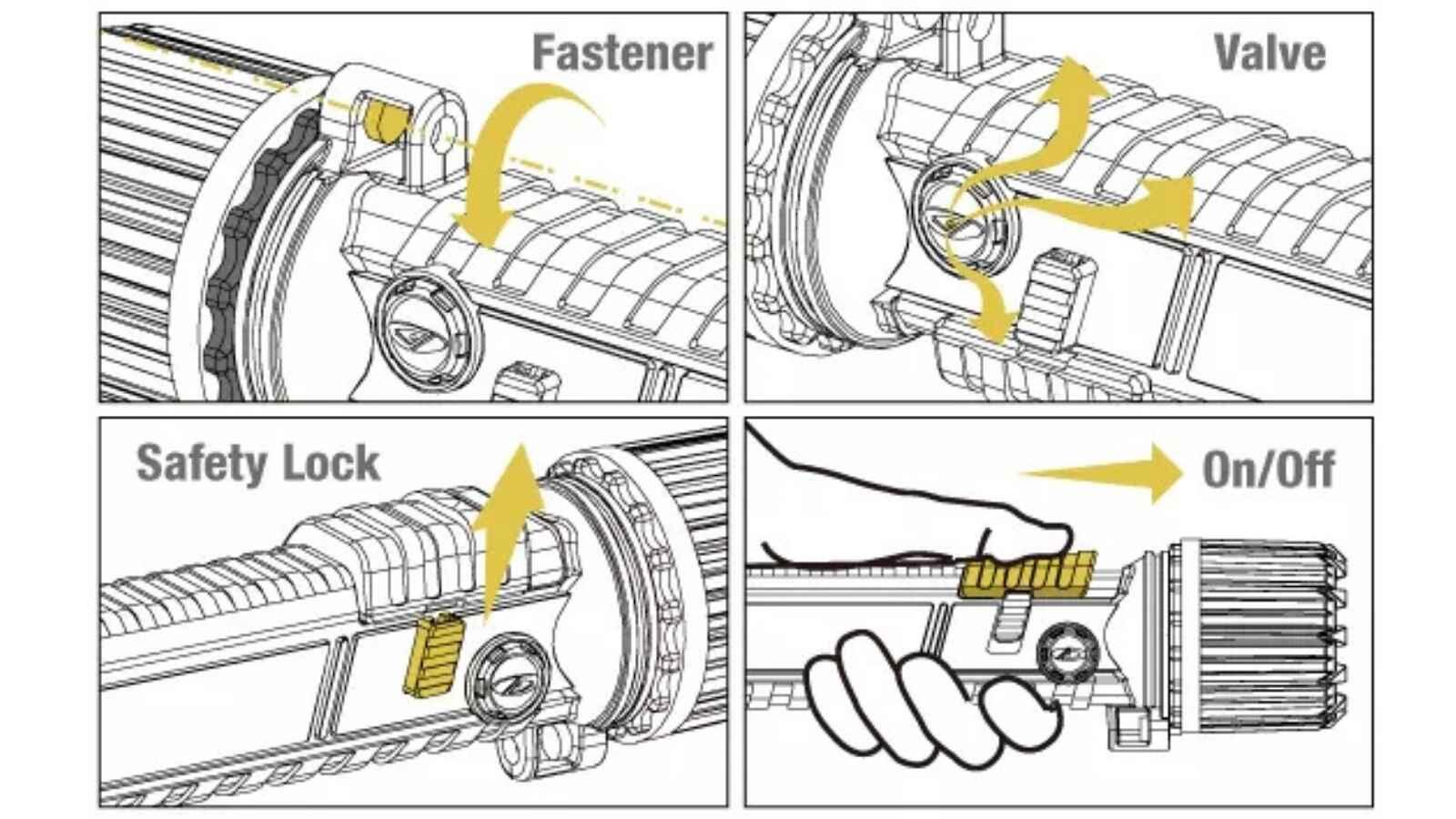
- Side switch with safety lock to prevent accidental activation.
- High-impact lens and impact-resistant ABS housing.
- Fastening screw keeps the housing from being opened unintentionally in hazardous areas, preventing the batteries from falling out.
- Vent valve helps release hydrogen gas generated by the batteries.
- Usable 3 m underwater; passed a 1 m drop test.
DS-1 Operation and Construction
Key controls and construction of the DS-1.
DS-1 Specifications
Brightness, beam distance and runtime are average values for high and low modes.
Hazardous Area Zones
DS-1 Explosion-Proof Certifications
The marking and certificate number of each certification scheme are listed separately. An "X" at the end of a certificate number means the certificate specifies special conditions for safe use; read the certificate before use.
DS-1 Applications
DS-1 for marine use and the oil and gas industry. Always check the hazardous area classification on site and the certificate conditions before use.
DS-1 Intrinsically Safe Flashlight FAQ
From how explosion protection works, Ex ia and zone classification, and reading certification markings to choosing a flashlight and its specifications.
Why won't an explosion-proof flashlight ignite gas? What is the difference between intrinsically safe and flameproof?
An explosion-proof flashlight is not "risk-free". It is designed so that it cannot become an ignition source. There are two common approaches.
Intrinsically safe equipment (Ex i) limits the energy in the circuit at the source, so even if a spark or heat occurs, the energy is too low to ignite the surrounding gas. Flameproof equipment (Ex d) uses a housing strong enough that, even if an explosion occurs inside, the flame cannot escape to the outside.
Put simply, intrinsically safe means "it cannot ignite", while flameproof means "if it ignites, it stays contained". The DS-1 is marked Ex ia, which is intrinsically safe, so it does not need a heavy metal housing and weighs only 140 g.
What is the difference between Ex ia and Ex ib? Which one is the DS-1?
Both are intrinsically safe. The difference is how many component faults the design can tolerate at the same time.
- Ex ia: remains safe with two faults at the same time. This is the highest protection level and can be used in Zone 0, the most hazardous area.
- Ex ib: tolerates one fault and is suitable for Zone 1 and Zone 2.
The three zones differ as follows:
- Zone 0: an explosive gas atmosphere is present continuously or for long periods, such as inside a storage tank.
- Zone 1: an explosive gas atmosphere is likely to occur in normal operation.
- Zone 2: an explosive gas atmosphere is unlikely, and if it occurs, only for a short time.
The DS-1 is marked Ex ia IIC T4 Ga. "Ga" is the Equipment Protection Level (EPL) and, like "ia", indicates that the flashlight can be used in Zone 0.
Where can the DS-1 be used?
In short, gas hazardous areas from Zone 0 to Zone 2, such as those in petrochemical plants, ships and natural gas facilities, are within the certified scope.
The North American cULus certification uses a different system. The DS-1 is suitable for Class I (flammable gases, Groups A–D) and Class II (combustible dusts, Groups E–G), Division 1 and Division 2, as well as Class III (ignitable fibers and flyings) locations.
Check the following three situations separately:
- Low auto-ignition gases: if the auto-ignition temperature of the gas on site is below 135°C, equipment rated T5 (100°C or less) or T6 (85°C or less) is required. Carbon disulfide, for example, generally requires T6, so this product is not suitable.
- Dust hazardous areas: this product's ATEX, IECEx and TS certifications cover gas atmospheres only. If the site is classified as a dust hazardous area (Zone 20, 21, 22), suitability cannot be determined from these certificates alone.
- Special conditions of use: an "X" at the end of a certificate number means special conditions of use apply. Follow the certificate when using the flashlight.
What should you look for in an explosion-proof flashlight for firefighting or emergency response?
The first step is not comparing brightness. First confirm whether flammable gas or dust may be present on site, and whether the flashlight's explosion-proof certification covers that environment. Once that is confirmed, check drop resistance, water resistance, protection against accidental switching and runtime.
Taking this product as an example:
- Explosion protection: gas atmospheres in Zone 0 to Zone 2 are within the certified scope.
- Durability: passed a 1 m drop test.
- Dust and water protection: IP68, usable 3 m under water.
- Accidental switching: the side switch has a safety lock to prevent accidental activation.
- Signaling and runtime: flash mode can be used for signaling; low mode runs for about 36 hours on average.
Confirming site conditions always comes first.
How do you choose an explosion-proof flashlight, and why do prices vary so much?
Check in this order: first whether the certification allows use in your location, then whether the specifications suit the job, and only then the price.
- Explosion protection: check that the protection type (ia, ib), gas group (IIA, IIB, IIC) and temperature class (T1 to T6) in the Ex marking meet the requirements on site.
- Certification region: ATEX for Europe, IECEx internationally, UL / cULus for North America and the TS Mark for Taiwan.
- Practical needs: brightness, beam distance, runtime, water resistance and weight.
One common reason for price differences is certification scope. Holding certifications for several markets and covering the most demanding gas group, IIC, increases testing costs. Materials, light source and structural design also affect price.
The DS-1 holds ATEX, IECEx and cULus certifications and has been certified by ITRI and registered under the Taiwan TS Mark. It covers gas group IIC, delivers up to 180 lm with a beam distance of up to 117 m, and is rated IP68.
What is special about the construction of an intrinsically safe flashlight? Why is this design common for handheld devices?
The key to intrinsic safety is the circuit, not the housing. The design limits voltage and current and controls energy-storing components such as capacitors and inductors, so the energy the circuit can release always stays below what is needed to ignite gas.
A flashlight runs on batteries and uses little power, which suits this approach and keeps it light.
Note that "battery-powered and low-power" does not automatically mean explosion-proof; formal explosion-proof certification is still required. Batteries are also a source of energy, so intrinsically safe flashlights usually specify the battery type.
The DS-1 also has three construction features:
- Fastening screw: keeps the housing from opening unintentionally in hazardous areas and the batteries from falling out.
- Vent valve: helps release hydrogen gas.
- Impact-resistant housing and lens: impact-resistant ABS housing with a high-impact lens, rated IP68 for dust and water protection.
What lighting modes does the DS-1 have, and what are its brightness and runtime?
Average values for high and low modes:
Lumens (lm) measure the total amount of light: the higher the number, the brighter the light. Use high mode to see far ahead, and low mode for long inspections to save battery power.


